Beta
Every Give and Ask fulfilled adds up. When you give or receive through the Buy Nothing app or website, we estimate the pounds kept out of landfills and dollars saved in your community, using text analysis and a custom model grounded in the EPA's Waste Reduction Model (WRM)
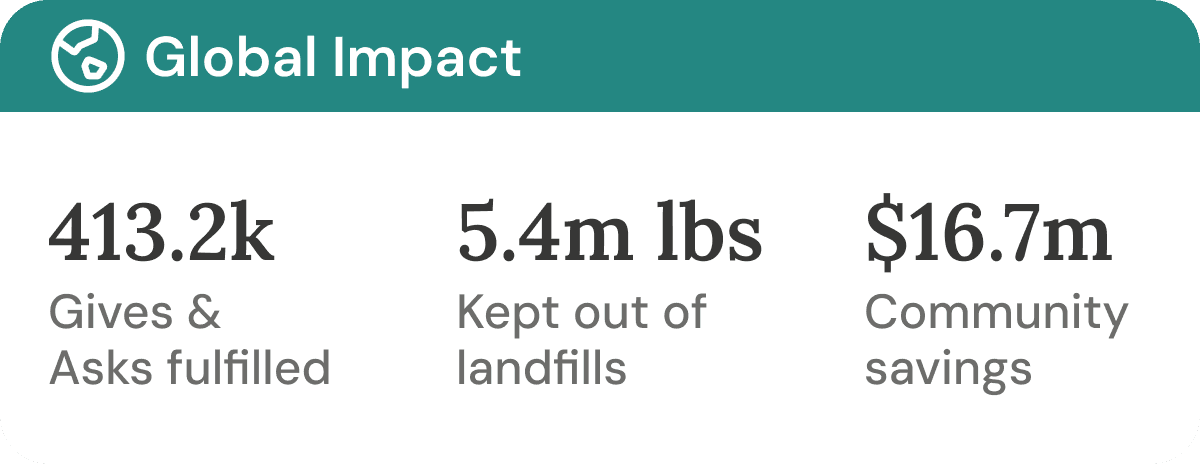
Your Generosity, Measured: Making a World of Difference
For years, the 15 million members of the Buy Nothing Project have been quietly changing the world, one gift at a time. Now, we have a way to prove just how powerful that generosity really is.
For members of the Buy Nothing Project app, we’ve built a first-of-its-kind system that calculates the real-world impact of every item shared in our community. By looking at what items are made of and what they typically cost, we can now estimate the actual weight, size, and dollar value of everything given away. To make sure our numbers are highly accurate and trustworthy, we even use the same environmental framework as the Environmental Protection Agency.
See Your Impact in Action
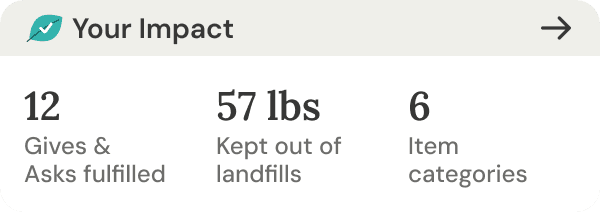
Every member will now get an Impact Dashboard. Think of it as your community scoreboard. It tracks:
Gifts Fulfilled: The total number of items that have been given or received.
Landfill Savings: The actual pounds of waste you helped keep out of trash heaps.
Community Wealth: The real dollars saved by neighbors helping neighbors.
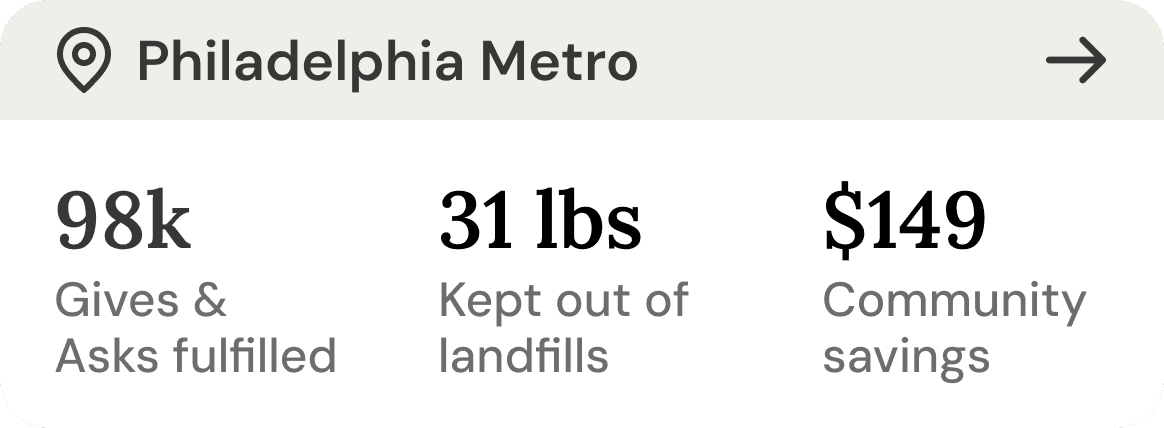
For Buy Nothing Pro subscribers, their Impact Dashboard becomes personalized. They will see their regional impact as well as their own personal metrics, including Gifts Fulfilled, Landfill Savings, and a breakdown of categories of items they gave or received.
Big Data for Big Change
Our goal is twofold. First, we want you to see the direct, positive ripples of your actions. Second, we are bundling these numbers together to show the massive, undeniable impact of local sharing at the city, state, and national levels.
These aren't random guesses—they are careful, auditable metrics designed to get smarter over time. We are excited to share this data, and we welcome partnerships with environmental agencies, researchers, and sustainability experts to show them what happens when a community decides to share instead of spend.
Thank you for being part of this movement. Together, we are proving that generosity weighs a lot—and means even more
How our numbers are calculated
Key facts about our data
Metrics reflect all-time since the Buy Nothing Project app launched in 2021.
Newly fulfilled posts will get counted in your personal stats within 5 minutes.
Posts before February 2026 may have less accurate estimates because we assigned categories retroactively.
Food and services are excluded from the metrics.
Weights and values vary by item. A coat, for example, could weigh anywhere from 1-5 lbs depending on fabric. We use averages.
Our model improves as we gather more data, so estimates may be updated over time.
Gives & Asks fulfilled
The number of Give and Ask posts marked as gifted or fulfilled to date.
How it works: Your personal Gives & Asks fulfilled adds up when you post a "Give" and mark it as gifted, or post an "Ask" and mark it as fulfilled. If someone else creates a post and you're the recipient (or giver), you will also see that reflected in your personal metrics tally.
Pounds kept out of landfills
An estimate of the weight of items given and received, based on standard average weights by item category.
How it works: We assign average weights to item categories using the EPA's Waste Reduction Model (WRM). For example, we estimate an average book weighs around 1.2 lbs, a kitchen item might weigh 2–3 lbs. When you give or receive an item in that category, we add that estimate to the total.
Community savings
An estimate of the economic value of items given and received, based on average resale values by item category in US Dollars ($).
How it works: We use the EPA's Waste Reduction Model (WRM) to estimate what items in each category might cost if purchased used. We user a combination of text classification and machine learning to estimate the sub-type of items within a category. A pair of jeans might have an estimated value of $30; a winter coat, $80. These are rough averages meant to show the collective community wealth being shared in your region.
Item Categories
How many different item categories you gave or received.
How it works: Posts created after February 2026 have categories assigned by you, while older posts are sorted into categories using a combination of text classification (analyzing the post title and description) and machine learning. Our model gets smarter over time as we gather more data.
Track your personal impact with Buy Nothing Pro
Upgrade to Pro to track your personal and regional impact metrics.
Frequently Asked Questions
Why don't my numbers seem right?
Because they're estimates. The weight of a "sweater" or value of "kitchen items" varies. We use averages to give a sense of scale without trying to measure every single item precisely. Our categorization model also continues to improve.
Why aren't food and services included?
Food exchanges are often immediate and informal, and services (like resume writing or home repair) are harder to quantify in terms of weight and resale value. We focus on physical items where the impact is clearer and more measurable.
Will these numbers change?
Yes. As we refine our categorization model and gather more data on typical item weights and values, the numbers may be recalculated. We'll let you know about major changes.
How do you decide which category an item goes in?
We use machine learning text classification to read the post title and description, then assign it to the most likely sub-category. Posts before Feb 2026 did not have user-defined categories, and may be less accurate. You can manually label your older posts with a top-level category to help us get it right. We are continually improving our text analysis to get more accurate categorization.